
Shortlet regulations in Lagos: what every host needs to know in 2026
Clavibase
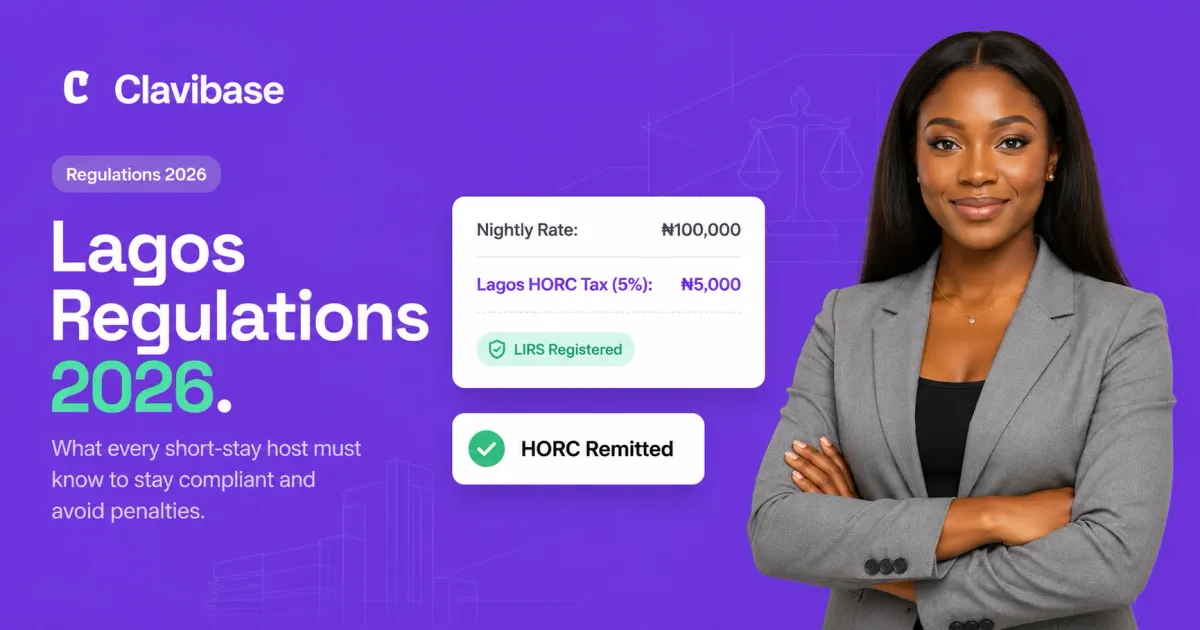
Lagos’s shortlet market has grown quickly, with listings spread across Airbnb, Booking.com, local platforms, and direct-booking sites. But regulation has not become any simpler. There is no single “Airbnb registration” process in Lagos, and hosts are often left guessing which rules apply to their property and business structure.
Here’s what official sources currently say, where the position remains uncertain, and what to check with a qualified adviser.
Lagos treats your apartment like a hotel
The rule that catches many hosts off guard is the Hotel Occupancy and Restaurant Consumption (HORC) Law of 2009. Its definition of a hotel includes guest houses, motels, and apartments used for short letting.
Under the law and LIRS’s published guidance:
- Covered hospitality businesses act as collecting agents for the tax.
- The stated consumption-tax rate is 5% of the customer’s total bill, excluding VAT and service charges.
- LIRS says tax collected during a month must be remitted by the 20th of the following month.
- LIRS uses the Eco Fiscal System (EFS) to record covered transactions and transmit them to its online tax system.
LIRS continues to publish and enforce these requirements. However, the interaction between state consumption tax and Nigeria’s federal tax framework remains legally contested. Do not assume that old guidance automatically reflects your exact 2026 position. Confirm your obligations with LIRS and a Lagos-based tax professional.
VAT applies too
Nigeria’s standard VAT rate remains 7.5% under the Nigeria Tax Act 2025, which took effect on 1 January 2026. Short-stay accommodation may be a taxable service, but exemptions and administrative obligations can depend on turnover, business structure, and other facts. The responsible federal body is now the Nigeria Revenue Service (NRS), formerly the Federal Inland Revenue Service.
VAT charged by a booking platform on its own service fee is not necessarily the same as VAT due on the accommodation you supply. Ask a tax professional to confirm whether you must register, charge VAT, file returns, or rely on an applicable exemption.
Check tourism and hotel-registration requirements
Lagos maintains official tourism and hotel-registration channels, but the exact route for an individual shortlet can depend on how the property operates. The Lagos tourism portal provides a business-registration route. Confirm the licence or registration required for your establishment directly with the relevant state authority instead of assuming that tax registration covers tourism regulation.
If you manage multiple properties, LASRERA may apply
If you operate as an agent who manages properties or lettings for other owners, registration with the Lagos State Real Estate Regulatory Authority (LASRERA) may apply. LASRERA states that real estate practitioners must be licensed and register their transactions. Review the official LASRERA guidance and confirm whether your activities fall within its definition of real estate practice.
Enforcement is not theoretical
LIRS continues to publish compliance notices for the hospitality sector and describes the HORC obligations as being in force. The law provides enforcement powers and penalties for non-compliance. Because the wider tax position has changed since the law was introduced, get advice before ignoring an assessment or assuming that a demand is correct. Ask for the legal basis in writing and respond within any stated deadline.
What’s changing
The Lagos State Tenancy and Recovery of Premises Bill 2025 remains a proposal rather than an enacted law as of September 2026. It passed its second reading and was referred to the House Committee on Housing. You can follow the bill on the Lagos State House of Assembly website.
The bill mainly addresses landlord-tenant relationships and recovery of premises rather than shortlets directly. Even so, changes to tenancy and agency rules may affect lease terms, subletting, and property-management arrangements if the bill becomes law.
A practical compliance checklist
- Ask LIRS whether your operation must register and collect HORC tax
- Confirm the current consumption-tax position with a qualified tax adviser
- Check whether EFS or another fiscalisation process applies to you
- Confirm your 2026 VAT registration, collection, and filing obligations
- Ask the relevant Lagos authority which tourism or hotel licence applies
- If you manage properties for others, check LASRERA registration
- Confirm that your lease, building, and estate rules permit short stays
- Keep written records of the guidance and professional advice you rely on
The bottom line
This is not designed to scare you out of the shortlet business. It is designed to help you avoid a surprise compliance problem or the late discovery that your lease or estate rules do not allow short stays. Clean records of bookings, payouts, and guest charges make tax reviews and professional advice easier. Clavibase keeps your core booking and payment records together so they are easier to retrieve.
This article provides general information, not legal or tax advice. Rules and official interpretations can change. For guidance specific to your property, business structure, and turnover, speak to LIRS, the NRS, and a qualified Lagos-based tax adviser or lawyer.