
5 signs you've outgrown manual shortlet management (and what to do next)
Clavibase
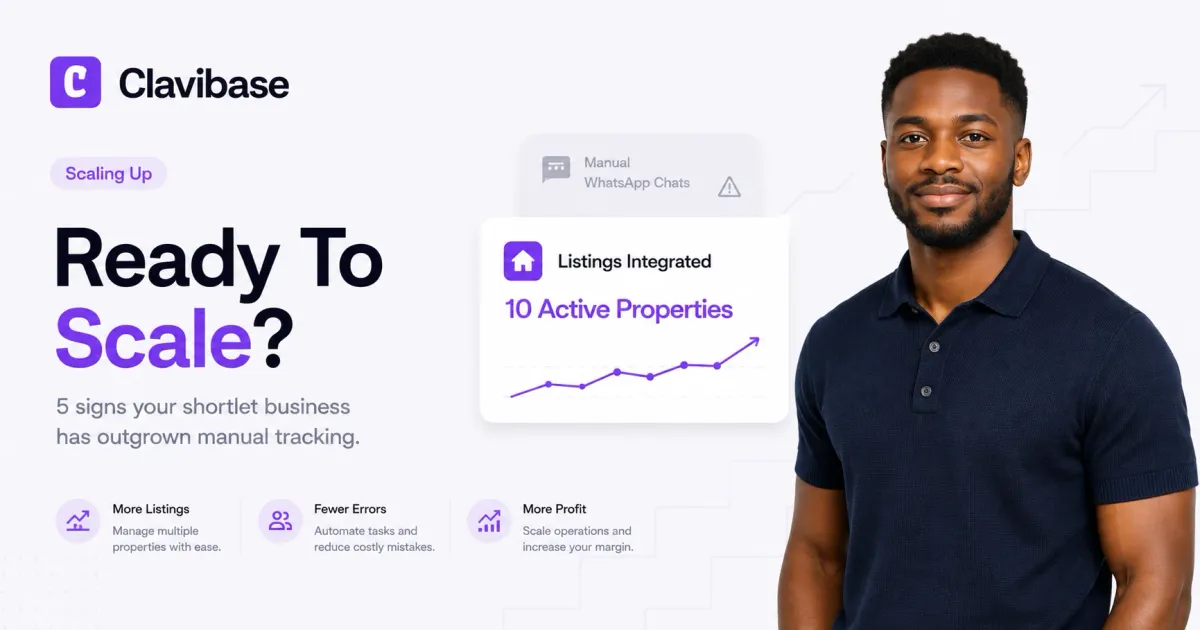
Manual management, such as a spreadsheet, a shared calendar, and a few DMs, can work fine when you’re starting out. Many hosts begin there, and there’s nothing wrong with it for one or two properties. The problem is that the system does not announce when it stops working. It quietly gets harder until one bad week makes the cracks impossible to ignore.
Here are five signs you’re past that point, and what to do about each one.
1. You’ve had a double booking (or a close call)
This is one of the clearest signals. If two guests have shown up at the same apartment on the same night, or you caught the conflict through luck rather than a reliable process, your calendar may have outgrown a spreadsheet. Manual systems have no automatic source of truth once bookings come in from more than one channel.
Fix: move to one calendar that updates automatically the moment a booking is confirmed, regardless of which channel it came from.
2. You’re losing track of who’s paid
“Wait, did they pay the balance or just the deposit?” If you’ve asked yourself that question and had to scroll through bank alerts to answer it, your payment tracking may have outgrown manual notes. This becomes harder as you add properties. A missed payment on one unit is frustrating; missed payments across five units can become a serious revenue leak.
Fix: a system that tracks payment status per booking, so the answer is a glance, not an investigation.
3. You’re replying to booking questions hours later
Replying to DMs personally is manageable at low volume. But once messages arrive faster than you can reasonably respond, especially outside work hours or while you’re physically at a property, you can lose bookings to the host who answers first rather than the one with the better apartment.
Fix: a booking page guests can check and act on instantly, so your response time stops being the bottleneck.
4. Adding a new property feels like starting over
If listing a new unit means recreating your tracking sheet, setting up a new chat thread, and manually cross-checking it against your other properties’ calendars, your system is not built to scale. It is built to handle only what you already have.
Fix: a setup where adding a property is a straightforward task, not an afternoon of copying spreadsheet formulas.
5. You genuinely don’t know your numbers
Consider your occupancy rate, average nightly rate, and best-performing property. If you would have to spend an evening reconstructing these figures from memory and old messages, you lack the information needed for decisions about what to price, what to promote, and what is worth your time.
Fix: a dashboard that shows you this at a glance, not a monthly spreadsheet audit.
The common thread
None of these five signs means you need to work harder or become more organised. They are natural results of asking a manual system to handle more properties, guests, or bookings than it was built for. The fix is not more discipline. It is tooling built for your current volume.
Clavibase brings bookings, calendar management, guest messaging, and payment tracking into one dashboard, so growing from one property to ten does not mean rebuilding your entire process each time. If two or more of the signs above sound familiar, it may be time to make the switch.
Ready to move beyond manual management? Start free with Clavibase.